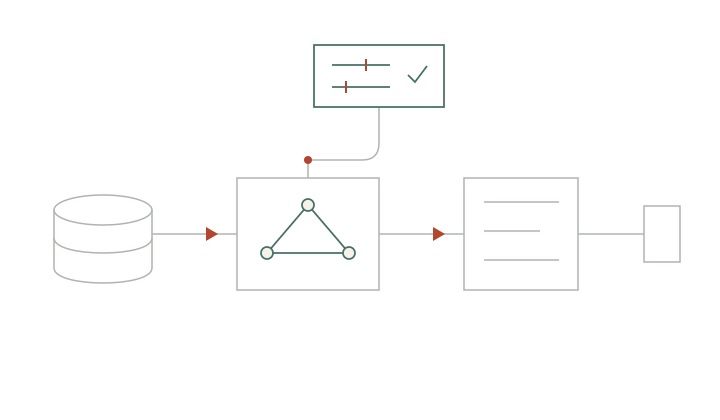
Context and retrieval
RAG and knowledge access designed around source quality, relevance and traceability.
Capability 04 · Applied AI
AI is useful when it improves a specific task under real operating constraints. We design the surrounding system—data, permissions, tools, evaluation, human decisions and fallback behavior—before treating a model response as a product feature.
Practical, bounded use
Useful applications can include LLM integration, retrieval-augmented generation, controlled agents, document processing and workflow automation. Each depends on the quality of the surrounding data, software interfaces and operating rules.
Engineering scope
Probabilistic behavior needs different controls from conventional software. Boundaries should be visible to the people using and operating the feature.
RAG and knowledge access designed around source quality, relevance and traceability.
The model or agent receives only the data and actions appropriate to the task.
Available APIs and operations are narrow, validated and observable.
Consequential actions pause for an informed person where judgment is required.
Quality is tested against real tasks and watched as data and behavior change.
The product remains understandable when confidence is low, a service is unavailable or AI should abstain.
How the system holds together
Some tasks benefit from language models. Others are safer, cheaper and easier to maintain with deterministic rules, search or conventional automation. An honest technical answer may be that AI is unnecessary.
Name the task, desired improvement and unacceptable outcomes.
Test AI against simpler deterministic approaches and a meaningful baseline.
Limit context, permissions, tools and actions to what the task requires.
Measure useful behavior, failure modes and the cost of human oversight.
Engineering qualities
Data sensitivity, retention, provider boundaries and access control shape what is appropriate. Private or local AI can be considered where the constraints justify it; it is not a decorative promise or an automatic requirement.
They may appear in a web or mobile product, use existing APIs and business data, or support a wider automated workflow. Integration and conventional engineering determine whether the feature is dependable beyond a demonstration.
An open invitation
Describe the task, information and decisions involved. We can examine whether AI, ordinary automation or no new technology is the sensible answer.